Wednesday, 6 May 2015

Speculations about methionine biosynthesis genes

Last year I wrote a review on the bacterial diversity methionine biosynthesis:
Ferla MP, Patrick WM. Bacterial methionine biosynthesis. Microbiology. 2014 Aug;160(Pt 8):1571-84.
PMID: 24939187, doi: 10.1099/mic.0.077826-0 and pdf.
It was crammed with facts and a couple of deductions that in my opinion are correct. However, there were a lot of hypotheses and conjectures, from plausible to wild, that did not make it into paper. Here I thought I might mention a few.

The MetCombo

It is my opinion that a bifunctional enzyme that catalyses both the MetC and the MetB reaction is impossible. I have come to call this hypothetical enzyme, the MetCombo. So the data at hand are:
  • MetC and MetB are close homologues and it is really hard to tell them apart in a phylogram —with the bold assumption that the uncharacterised genes are what have been guess.
  • Both KEGG and EcoCyc take the close homology to mean that bifunctional enzyme is present in several organisms —basically all those with MetB, which is a lot as you know from the met biosynthesis paper
  • They are in the same pathway
  • Nobody has ever seen a metCombo
  • Papers that try to evolve MetC ↔ MetB are not realy successful
  • Personal results: E. coli metC cannot rescue metB
  • Personal results: Thermotoga maritima "metB" is actually a metC and it has no in vivo or in vivo MetB activity(check out my thesis)
  • Catalytically a metC and metB in a single active site would be a disaster.

Catalytic profligacy
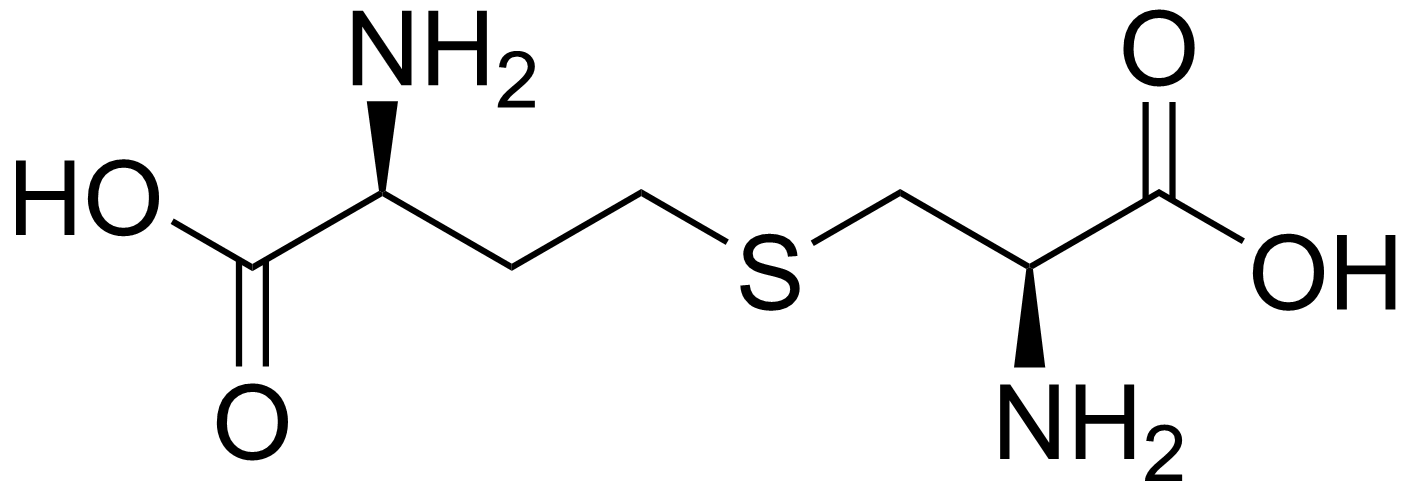
Cystathionine is a cysteine/alanine and a homocysteine/homoalanine joined together with a thioether. It has a short side (S is on the β) and a long side (S on the γ).
MetC is cysthationine β-lyase, it eliminates cystathionine at the thioether bond. On the shorter side (β).
MetB is cystathionine synthase it eliminates O-acetyl-homoserine at the ester bond and then attacks it with cysteine's thiol making cystathionine.
The two PLP enzymes hold cystathionine at some point but in radically different ways, one on the β side (MetC), the other on the γ (MetB).
Taking a step back, we have two types of cystathionine lyase and what controls the specificity between a β-lyase and a γ-lyase is not known —there have been a few papers looking into making MetC into a MetB and viceverse, but unfortunately nothing tackling this simpler issue. Cystathionine looks nearly identical from both sides: the sulfur bridge is hard to tell apart from a methyl group as there is only a slight size and charge difference. Methionine can be substituted with norleucine in protein with only minimal effect. Therefore it is intriguing how the enzymes bind it tightly in a specific way. My theory is that sulfur-π interactions may be involved as there are several tyrosines in the active site of MetC. Additionally, a β-elimination might be easier than a γ-elimination, therefore it is shame that there is a decent amount of data of the lack of γ-elimination activity in the β-lyase, but not viceversa. Therefore it would seem more likely to have a powerful bifunctional β- γ- cystathionine lyase than have retrained one that is strongly specific. However, this bifunctional enzyme is not an evolutionary a good idea due to the number of round trips it would do. Specifically, cysteine or homocysteine would go into making cystathionine, which the uncommitted lyase would either correctly transform or return a starting substrate —at the cost of ATP. The reason for this fascinating parenthesis is to conclude that cystathionine synthase/lyase combo that could do both, would be equally as bad of an idea —it would work due to flux from excess substrate to product in demand, but it is just extremely inefficient.

Conflicting results

Some methionine gene rescue experiments go in different ways that expected and there occasionally are concentration dependent oddities. My opinion is that this is due toone of the following:
  • It is dominating the threonine branch point and there is not enough threonine being produced.
  • It is depleting all the cysteine or homocysteine
I like the idea of enzymes being repressed from doing something easy, but bad on an aside (e.g. MetC can eliminate serine), but I don't think it's the case here. Unfortunately the only way to find out is to actually test whether the oddity perseveres when threonine and cysteine are added.

The ancestral PLP-dependent methionine gene

TBA

Methionine and norleucine

TBA

Alignment file

Here is the alignment file of manually aligned genes of various metB metC etc.

Tuesday, 3 March 2015

Bacterial Dissociated Press

UPDATE: The code has been adapted to become am online bacterial name generator thanks to Brython.
There are several ways to make a random name generator and it depends mainly on the probability of the letters. A Markov chain is a model where the probability of finding a letter depends on the previous letter(s). In the script I wrote, the first and last letters are underscores thus preserving the probability of first and last letters, the downside is that there is no letter minimum or maximum:
These are two names I got out of 100 trials:

  • Cobaceobacumomyeriflvijerellaniocidenactilasttiacobacoballlitelanas priartrogntubophae
  • Ps ge

The dataset used to obtain the probabilities of letter combinations (training) influences the results obviously. Here I parsed LPSN for species names and treated the genus and the species epithet differently.
Amusingly, using only two letters combinations gives fairly Latin sounding names. Here are five non–cherry-picked examples:

  • Vucocovinenacrenistrngidobacirdocotromyconsipumostereus ateue
  • Peus s
  • A zonvi
  • Aceropareainobastheptha menzi
  • S lfa
  • Kllacererhelucoccimycelusm ngum
  • Lumibodom pensidiaqiscusicanise
  • M psplumolinisonolacia
  • Rerella or
  • Lochadibriciziberononacomyctritr selietimolerbumiseelaltaleni

They look like species names, but are not quite right. Some affices appear as 'Kllacererhelucoccimycelusm' testifies (cocci, myce), but also impossible consonant clusters for Latin (klla, which I'd try reading that as kł; ng at the start of a word is a normal in many languages, but Latin does not have a ŋ sound). Going through the list there are some cool ones that look diabolically hard to read (Seogactychoreriumacesheraes wautenditolans), have more Welshness (Llacosula thiabisini) or have recognisable words (Mum joliaiinecuvigoransis).
When the kmer is changed from 2 to 3, the names make a lot more sense. A lot more affices surface and less weird consonant clusters. Here are 100 non–cherry-picked entries.
I like that one is 'Clobacterium aliens'. There are some other real words and some odd ones, such as yogalitre —a novel bohemian unit of volume.
  • Enoalobariononasacter futerxiackitrum
  • Lapper ase
  • Paulfobiumickeyerium yogalitre
  • Strellum gitormeneaericus
  • Shellococolanoreptomycococchrio mens
  • Chthenia fentanonii
  • Sacilla abus
  • Strevosphinobiseudoanopla baalii
  • Microidus cociensis
  • Sporynes virotum
  • Microma aneaxenni
  • Bacteimetocobactomonomicinorynterogangioidethia turomedurpellis
  • Clospora aliensiseudorandrophamper
  • Des paris
  • Clostrenematisher phizoreens
  • Microbacter ansifixtrolytins
  • Acterium psyrarchens
  • Clostreptomuromanterobium gina
  • Bureptostrevoserobacter amardaenii
  • Phaeudobacillusobactomadalmotenbellus aturivalinastis
  • Nobactia senteriensis
  • Clobifidiumonaeriomacinocellus glus
  • Derium se
  • Psia se
  • Preptoraneobactetacter prosalisquaes
  • Actima vense
  • Gemacia crynifichilum
  • Angobacilla chaiwalficaphiphilutyris
  • Exus thens
  • Mer imarinus
  • Streptophizawanorevibactermonas mesbensis
  • Furax anderobicum
  • Flactermonas paramesolachilum
  • Sulus sisidigii
  • Pseudoalder cophiilatis
  • Haenimicrobacila vionii
  • Stahayloseucocorobacilelochrotrea piresele
  • Bacillus agnis
  • Statospormonovobachabacteobacilibrix koreschum
  • Burkhodosalicronoccus licuni
  • Des nonca
  • Ardium sponensis
  • Aces cysalkii
  • Coccus permervensicarinea
  • Streptophizobacterotobacillatomycetburadsketinossobactellum chrophitrariosteracecidiolipalense
  • Streptobacilebacillum sphonensii
  • Rum tus
  • Macesula rundebens
  • Sponaeringomonas sophagii
  • Lyanosphoebacterium matus
  • Amurandroidia clocynitucum
  • Chizoodomicillanelluseubroidobacococas hungbaiwadimuyanensis
  • Xybacterium alkapiensis
  • Amycetoba solitophae
  • Actomonaspobactomonia mer
  • Clobacterium aliens
  • Pla fereenzotidimareequatus
  • Er premanum
  • Xanomonerium licatus
  • Methylososphio inaeens
  • Pedium inans
  • Matoces marum
  • Paea mae
  • Nostreptomanobacter montemophiganginhila
  • Almonaenoclovardium nerrakus
  • Metherococycobium flugongtoriensisciforyntica
  • Seudocococchaenibbellus thilucentoluceus
  • Mydobacter pedia
  • Hangium facransis
  • Strenebsibacromycona lacamingensii
  • Agium stidalis
  • Glum stans
  • Des vibensenigens
  • Cobacteudonacteringium inis
  • Es amitra
  • Alium thili
  • Palgomaduradreptomona wolis
  • Brix vi
  • Phillas marboryzaeongwanenicus
  • Bium callus
  • Zhio lense
  • Thanas wayticolipleolensicalbies
  • Nospirsia ebadiaense
  • Des adaicowskiabilicus
  • Kocococolamsis ans
  • Amyces danivoranse
  • Bruiherillosporreptomyces thillupraecae
  • Satrellas geolisis
  • Des stum
  • Bacillum putiduciticus
  • Stertingobium stenti
  • Spirga odanae
  • Roger oleovoricula
  • Feria asterium
  • Pellacteriodoccus flatus
  • Sphylobacter yogensis
  • Pseudobacter sis
  • Sphomyxillimora latus
  • Strepla puyatlasis


Monday, 16 February 2015

Vulcan birthday calculator

When is it my Vulcan birthday?
For the exact length of a Vulcan year check below.

Caculator


Please insert your date of birth or age and the Vulcan year estimate:

DOB day:
DOB month:
DOB year:
Alt: Age:
Vulcan year length:


Vulcan years: 124.1
Next birthday: 5 Jul 2016


How long is a Vulcan year?

I have found three dates:
  1. According to Memory Alpha Gene Roddenberry gives a Vulcan year as 456 ± 33 Terran days, which would make it a freezing iceblock.
  2. Memory Beta has different, more realistic values. The only sourced one is 266.4 days, which is still on the chilly side for 40 Eridani.
  3. On Star Trek Star Charts (2002) page 58 the year lasts 248 days.
Additionally, we know the following information:
  • Vulcan is a warmer planet than Earth
  • Vulcan (T'Khasi) orbits an orange star (Alam'ak, 40 Eridani A, spectral class: K1V), which is much cooler than Sol, a yellow star (G2V)
Consequently, it should be around 200 days.
However, there is the possibility that the definition of year (tevun) might not be an tropical orbital period around 40 Eridani. If there were little axial tilt and a near circular orbit, seasonal difference would be less pronounced (Game of Thrones's years Westeros can be explained this way in conjuction with short Milankovitch cycles).
PS. If you have any useful figures or facts about the year length, please do share!

Friday, 15 August 2014

A look at Nature's profits

Who in their right mind pays thirty-two bucks for a pay-per-view article?
I assume nobody. If you can understand a jargon filled peer-reviewed article on muonic neutrinos, the chances are you know someone whose academic library has access. But if that is the case why bother?

I would guess it is make the library subscription prices a bargain, after all one issue of Nature bought from the shop costs ten pounds (15 USD) whereas a annual personal subscription comes to 4 USD per issue. Namely the usual bulk sale. Apart from the small details that (a) in both Nature and Science the per issue cost printed on the cover (10 units of some currency) has not changed for decades and (b) newsagents do not sell New Scientist half the time, so will never sell Science or Nature.

As it turns out, a private university in Texas (Trinity University) with 2.5k students did a trial where the library  cancelled its subscriptions and used the saved money as a fund to buy all the 30$ articles students and faculty needed. Suprisingly, it was a success according to the article I found —wikipedia does not mention if they still do it, but it does say the library has an acquisition budget of 1.8 million dollars per annum.
Annoyingly, few numbers are given in that article, except for the number of articles bought in December 2007, which was a meager 220, meaning that, assuming the students were illiterate, each faculty read only one article per month. I think I can safely say that random articles of the internet are not to be trusted.

Nature Publish Group had a quibble with the University of California over its extortionate library subscription of over one million dollars per annum. Assuming that the pricing depends on the student population —I do not know if that is what they do, I am just guessing— the university pays seven dollars for each of the 160,000 students per year to access NPG articles. Which would mean that a library subscription is cheaper than pay-per-view if on average a student reads more than one NPG article for his/her whole degree. So my guess could be right.

Six dollars per year per student sounds like a bargain: it is one 33rd of the price of a yearly subscription, which sounded like a bargain to start with. So, they are loosing money and not making it, right? Actually, they still manage a 15-19% profit margin.

In the Select Committee on Science and Technology, there is an interesting (phantasmagorical) deposition by NPG (link) where they show some very weird figures:

  1. Annual income of Nature: 30M GBP
  2. Articles per year in Nature: one thousand (1/10 of those submitted)
  3. The "front half" (the intelligible bit) takes up 2/3 of the cost
  4. Editorial board: 43% cost
  5. conferences and overseas travel: 1%
  6. printing and distribution: 31%
Now, I fully see why it is called Nature: it is as badly organised as a biological system.
So they pay the editorial board 13 million per year to review one thousand articles. The worse case scenario is that they have 650 editors paid equally 20 k GBP pa. to review twenty articles annually. My guess is that there are many fewer editors than 100 (@ 100, 130 k GBP pa for ten articles per month), who get paid serious money (unlike the peer-reviewers) and go on loads of conferences.
That two thirds of the costs go to the nice summary articles that only people with the printed versions read baffles me entirely.
Basically, I thought these chaps were evil, but it turns out they just like spending money badly like the rest of us.

Update: my google search victim (NPG) is not the worst offender. It actually is Elsevier, which makes 34% profit margin, which "makes Murdoch look like a socialist" according to the Guardian...

Tuesday, 12 November 2013

The not-green ocean

That the ocean is blue and not green is evident, yet the reason for this is not as silly as one would think.

In fact planktonic algae are not as abundant as they could could be, if it were not for phosphorous and iron limitation. If life could survive off air and the minerals in sea water alone, the ocean would be as green as a rainforest —or whatever colour the photosynthetic pigment of this hypothetical life were to be. Light gives power, carbon can be fixed from carbon dioxide and amino groups can be obtained from nitrogen gas —with some trouble—, while phosphorus tends to be insoluble so comes from rocks: there are no rocks on the open ocean surface.

There is a counter-intuitive phenomenon called eutrophication where, when nitrogen and/or phosphorus get dumped into a river or lake, an algal bloom occurs, which blocks the light to the bottom of the watermass and the decomposing dead alga result in oxygen deprivation. This just show how some elements are the rate limiting step for a green watermass. Adding nutrients before the tipping point, results in a more lush ecosystem. There are a lot of pipe-dreamy talks of phosphorous and iron fertilisation of the oceans to combat CO2 levels: forest occupy only 7% of the planets surface, whereas oceans occupy 71%, so there is a lot of carbon fixing that could be going on that isn't. What interests me, however, is how could Nature overcome the issue.

Ammonia causes eutrophication because it is limiting as nitrogen fixation is neither simple or cheap, but it can and is made, albeit slowly. The major issue is the fact that splitting N2 costs 4 pairs of high energy electrons and O2 quenches the reaction in nearly all nitrogenases.

Whereas strategies to avoid oxygen sensitivity in nitrogenases can (and maybe has) evolve, phosphate and iron limitation is an insurmountable issue.

Iron is a big problem, for starters no iron means no heam and no iron-sulfur clusters, which catalyse several complex reactions, including that of nitrogenase. The problem is actually greater as except for alkali metals, there are a few parts per billion or less of most metals. The reactions vary, but not many of them could be substituted by hypothetical delocalised pi orbitals, other larger elements and similar. So the metal dependence is unavoidable.
Also, it is a fairly safe guess that life will not evolve to be phosphorous-less any time soon: the genome (DNA) needs it, the transcriptome (RNA) needs it and the cellular energetic currency (ATP) needes it. The best evolution can do is to streamline the genome to the bare minimum. There is a lot of talk about nucleic acid analogous with carbon-based backbones, most which do not form helices but tangled messes —hey, they are still amazing. So engineering such a phosphorous-free organism is out of the realm of what is current feasible in synthetic biology and more in the realm of science fiction. Plus, if the oceans were dominated by a (planet-saving) spooky GM organism, prince Charles would never shut up.
I am not aware of any other oxygenated multivalent ions that would fit the bill or that have even been tested, for example nitrate-backboned DNA would be very explosive, whereas sulfate-backboned DNA would be neutrally charged, but the question if an element other than phosphorous would work is pretty cool and is comparable to the debate of the fictional arsenic bacterium.
If there were some non-phosphorous system that did form helices… the genome would still be different, requiring new polymerases and XNA-binding proteins. The transcriptome would be different as RNA would not fold making riboswitches, tRNA and other quirky RNA structures unusable. The transcription machinery would have to be fully proteinaceous. The energy storing bond would have to be something different (acetyl-CoA or something radically new)... but rather cool.

Thursday, 5 September 2013

Conferences (NZSBMB)

Report for the NZSBMB

Conferences are about learning. And from them I have learnt a lot, not only in terms of scientific knowledge, but also in terms of common sense.
I went to two conferences in July, namely SMBE 2012 (Society for Molecular Biology and Evolution) in rainy Dublin —Ireland was rightfully called Hibernia, the land of winter, by the Romans— and the Gordon Biocatalysis 2012 conference in sweltering Rhode Island.
The first thing I learnt was that three successive red-eye flights are a bad idea regardless of cheapness and of how well-travelled one is as no amount of travelling can make one prepared for it. Another thing I learnt was that when the airhostess insists a poster-tube be given to her for stowage one should behave like a tigress protecting her cubs, lest one want it inexplicably sent to Denver…
The lab I work in studies enzyme evolution via promiscuity, which means that we scare evolutionary biologists by talking about kcat and KM values and enzymologists by talking about selection pressures. Therefore, I went to two conferences, one for each side. The work I presented as a poster was the change of various enzymatic activities (main and promiscuous) of an enzyme across different lineages.
The SMBE is a big conference, which is not necessarily a good thing. There were six parallel sessions, which nominally means one could go to relevant ones and avoid the irrelevant ones and within the first day I mastered the art of flitting from one session to the other. However, I soon found out that some sessions I was very keen on were full to (EU fire-code) capacity. A further side effect of parallel session is that often one has to make a tough choice between two interesting talks, whereas at other times one has to choose from a series of utterly uninspiring talks.
In addition to talks, there were the poster sessions, where I presented my newly reprinted poster. Many complicated factors are at play in the (unappreciated) art of poster placement in a hall. The main factor that determines whether a passer-by stops to read a poster is not due to the content —although a QR code can help—, but due to the presence of other readers (nucleators). Therefore, due to the queues, being close to the bar is probably one of the best places to attain this phenomenon. And next to the bar was exactly were my poster was.
My second conference, the Gordon Biocatalysis conference, was diametrically opposite: it was small, which meant it was a good environment to easily interact with other participants, both students and faculty. The talks were longer (i.e. not crammed) and all were fascinating. I left the conference having met many really smart and nice people, having learnt a lot about the frontiers of research and having been awed by what the future holds in store.
I did however learn another piece of common sense, namely to not make promises that can’t be kept: I promised Wayne, my supervisor, I would not do anything embarrassing, yet I did so twice. In a first instance, there was a discussion of Star Trek that degenerated into a biggest trekkie competition, which I unfortunately “won” by having been wearing star trek themed socks. Then during a free afternoon, I let out a bellowing scream when a volleyball flew towards me —referred to by others as my Klingon battlecry. Not my finest hour…