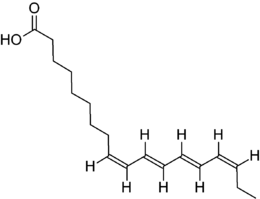
Desaturated fats generally have a
methylene-interrupted configuration, where a double bond is separated by two
single bonds. Conjugated fatty acids (aka. polyene fatty acids) are fluorescent
when in a lipid bilayer (Sklar et al.,
1977), but
few examples are know.
One example is parinaric acid (octadecatetraenoic acid; pictured) from Impatiens balsamina
(also found in the unrelated plant Parinarium laurinum; this is not a former name for Impatiens balsamina) with
four double bonds (ex. 320 nm → em. 420 nm) and with a characterised conjugase (Cahoon et al., 1999). Other conjugases have
been studied (Rawat et al., 2012) and other conjugated fatty acids are known,
including one with 5 double bonds (bosseopentaenoic (eicosapentaenoic) acid).
A single enzyme that makes a fluorescent reportable signal is rather appealing for synthetic biology.
The wavelength is rather limiting compared to aromatic compounds obviously. Namely conjugated butadiene, hexatriene, octatetraene, decapentaene and dodecahexaene absorb at 217 nm, 252 nm, 304 nm, 324 and 340 nm respectively. The fact that two or three conjugated ene bonds would not suffice as a tool raises the question of whether a
conjugase could be evolved to make even more conjugated systems, such one acting on
cervonic acid (22:6(n-3)), which would make a fluorophore of seven conjugated ene bonds. As a fluorescent signal is easily selectable by FACS, it would be definitely doable (if the UV lasers were available). The only problem is that E. coli lacks variety when it comes to membrane facts as is mainly composed of palmitic (hexadecanoic) acid, palmitoleic (cis-9-hexadecenoic) acid and cis-vaccenic (cis-11-octadecenoic) acid (Mansilla et al., 2004), therefore, the desaturation machiner to make the precursors would be needed. Nevertheless, it is rather interesting and I would love to see more colourful E. coli...
EDIT. Isoprenoid and is condensed derivatives (geranyl-PP, farnesyl-PP, geranylgeranyl-PP etc.) already have a methylene-interrupted configuration and geranylgeranyl is condensed into phytoene which is desaturated by phytoene dehydrogenase to lycopene.
Archaea use diphytanylglyceryl phosphoglycerol is their cell membranes: phytanol is reduced geranylgeranol. So their reduce it as opposed to desaturating it, if they did you'd 5-7 conjugated ene bonds, which would absorb in the yellow region.